
You’ve invested in software to make your business run smoother, better order management, cleaner distributor workflows, real-time sales visibility. And for the most part, it works.
Until it doesn’t.
Orders are piling up.
A distributor can’t place an order.
Your field sales app is throwing errors.
Billing at a key outlet is stuck.
And in that moment, the last thing you need is to raise a ticket and wait for system support.
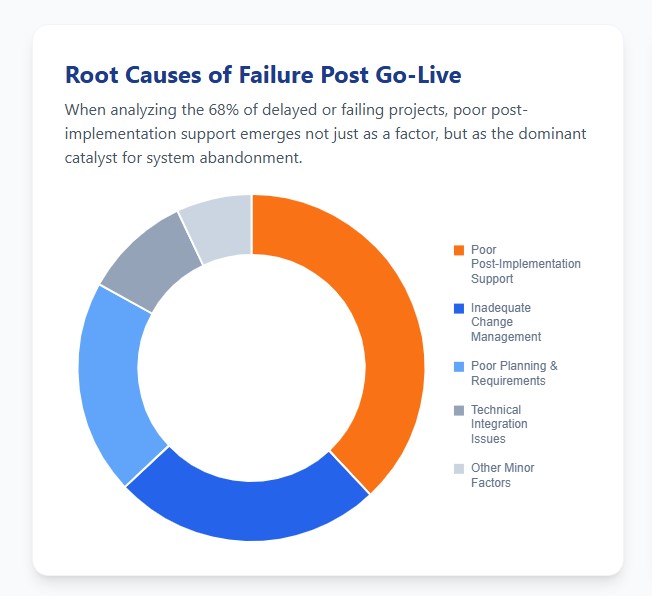
According to research by Gartner, while modern enterprise systems are designed to streamline and optimize business operations, more than 70% of ERP initiatives fail to fully meet their original business goals, with a significant number failing altogether.
This highlights a critical gap:
even as systems evolve, the support and execution around them often fall short when businesses need them most.
Businesses aren’t failing because of bad software.
They’re failing because the support behind it disappears when it’s needed most.
The Way System Support Usually Works (And Why It’s Broken)

Across most ERP, SFA, and POS platforms, the system support structure looks roughly the same.
You raise a ticket.
Via email, an in-app form, sometimes WhatsApp.
The ticket enters a queue.
It gets tagged by priority and module.
A Level 1 agent reviews it, figures out whether it’s a bug, a training gap, or a configuration issue.
If they can’t solve it, it moves to Level 2.
If Level 2 can’t crack it, it goes to Level 3, a developer or product specialist.
How ticket-based System support lacks, and how businesses are impacted
- Tickets are considered as individual issues.
They are isolated by the problems, and not by the business or person. This means, issues are handled without having any context of your business nor the impact. - High volumes of tickets can overwhelm the support systems, causing bottlenecks and longer queues.
Businesses are required to wait for hours for their tickets to get acknowledged while the issue actively disrupts the business flow. - Most ticketing systems require internet connection, which is not ideal for businesses having kitchens or kiosks in poor network service areas.
- During rush hours, if systems stop working, businesses opt to workaround manually while waiting for the ticket to be acknowledged, leading to data silos and inefficient operations.
- In QSR businesses or outlets, time is everything. A 15-min delay in a high-turnover cafe can cause customers to turn back and leave one-star ratings, only because your billing and order processing system was stuck and waiting for the ticket to be acknowledged.
- Delivery delays and mismatches damage the brand’s reliability and customer trust, what was just a small tech issue in queue waiting to be resolved reflects into something far critical for the business.
- In FMCG distribution, the stakes are just as high. A two-hour window where your distributor can’t place orders isn’t just a tech issue, it’s lost stock, delayed deliveries, and a retailer who runs out of inventory by evening. Your field sales rep can’t record collections during beat. Your van loading gets misaligned. What starts as a software error quietly becomes a supply chain problem.
- Tickets are often prioritized based on their tech definitions and not their business impacts, a small UI glitch might just be a small tech issue, but it is disabling sales reps in placing orders in real time.
- Tickets often require end users to provide “error logs”, “console snapshots” etc. when they only know that the place order button is not working. When technology makes a frontline worker’s job harder instead of easier, they stop using it. They’ll revert to pen and paper, making the expensive system useless.
Each handoff takes time.
Each new person needs the entire context.
You end up explaining the same problem three times to three different people.
And through all of this, your operations are still waiting.
And the more customized your setup, the slower this gets.
That’s just the reality.
Ticket-based system support made sense when software was simpler and businesses were uniform.
But businesses can’t solely work on ticket timelines.
Each business is different, each operation is distinct.
Let’s be specific about the stakes here.
When your system goes down or throws an error during a critical window:
– Production data gets misaligned
– Distributors can’t place orders
– Field salespeople can’t record beats or collections
– Outlet billing gets stuck
– POS goes down during rush
– Franchise outlets lose sync with the central system
– Kitchen order displays stop communicating with billing
– Your team starts making calls to figure out what’s happening instead of selling
Every hour of unresolved downtime has a real cost, in orders lost, in distributor frustration, in field team productivity.
It’s not just an IT problem anymore.
It’s a revenue problem.
How this escalates as businesses scale:

Most businesses implement systems while they’re growing, when operations are still under control and issues feel manageable.
But scale changes everything.
Complexity increases. Dependencies multiply.
What once worked as a simple system support process starts to fall apart.
Issues are no longer isolated.
They’re deeply tied to your operations affecting production, distribution, and revenue in real time.
And in moments like these, tickets and emails aren’t enough.
You need someone who already knows your business inside out, someone who understands not just the issue, but the impact behind it.
At scale, support isn’t just about resolving tickets.
It’s about understanding operations, ownership, and speed.
Byte Elephants: From Tickets to Ownership

At Byte Elephants, we don’t operate on a ticket support system.
Every client gets a dedicated SPOC, a Single Point of Contact who is directly responsible for your account.
Not a generic helpdesk.
Not a rotating support queue.
One person.
Who knows your business, your setup, and your workflows.
What that looks like in practice:
You face an issue.
You call your SPOC.
They pick up and get on it, in real time, not after any queue clears.
If they can resolve it then and there, it’s done.
If it needs deeper investigation, it’s immediately handed to the right person, with full context already passed on.
- No re-explaining.
- No waiting in ticket-queues.
- No “your ticket is getting re-assigned”.
Every issue is categorized by its real-world impact on your operations.
For critical failures that threaten your daily business, like a POS outage during peak hours, our support provides an immediate 2-hour response and a full resolution within 24 hours.
We don’t just manage issues; we protect your uptime.
What Onboarding has to do with Support:
Most businesses think of onboarding and system support as two separate things.
Implementation happens, then support kicks in when something breaks.
But that’s not how it actually works.
The quality of your support is determined during onboarding, not after.
When your SPOC is involved from day one, they’re not just learning the software.
They’re learning your business.
Your order cycles.
Your peak hours.
Your distributor relationships.
Your custom configurations.
The workflows that are unique to how you operate.
That context is everything when something goes wrong.
This is why at Byte Elephants, your SPOC isn’t assigned after implementation.
They’re with you through it.
By the time you’re live and running, they already understand your operations well enough to diagnose issues faster, escalate smarter, and resolve problems with context, not just technical logs.
Most growing businesses need an IT consultant but can’t justify hiring one full time.
Your SPOC fills that gap.They carry both the technical depth of someone who knows the platform inside out, and the business context of someone who has been with you since day one.
Support isn’t just a post-implementation function.
It’s a continuation of the relationship built during onboarding.
The Escalation Matrix: Real People, Real Accountability
Here’s something most support systems will never give you, a named escalation path.
Not a generic support email ID.
Actual names and direct contact information at every level.
The structure is straightforward:
SPOC → Product Consultant → Project Manager → CTO
If your issue isn’t resolved at one level, you know exactly where to reach next and you have their contact already.
There’s no mystery about who’s responsible.
There’s no “escalating internally” with no visibility on your end.
You are there, in loop with every update and status, live.
No more guessing, no more “checking in” via emails.
→ Your distributor can’t place an order at 11 AM.
→ You call your SPOC.
→ Instantly, the issue is identified and escalated with full context.
Most platforms give you a ticket number.
We give you a dedicated person, someone who understands your business, your requirements and the impact.
The Bottom Line

Support is not a backend function anymore.
It’s part of your operational infrastructure.
Modern businesses move fast.
Your software should keep up, and so should the people behind it.
The difference between ticket-based support and SPOC-based support isn’t just about speed.
It’s about ownership.
Your SPOC is with you from day one, from initial implementation to ongoing backend support as your business scales.
It’s not just support on request, but a consistent point of ownership you can rely on when it matters most.
When you have a dedicated contact who knows your business, an escalation path with real names, and contractual commitment,
support stops being a frustrating process and starts being a genuine safety net.
So ask yourself this.
If your system stopped working due to a technical issue right now in the middle of your operations, during peak hours what would happen next?
Would you be raising a ticket…
waiting in a queue…
following up on auto-generated responses…
while your business waits with it?
Or would there be immediate coordination, someone who understands your setup, picks up your call, and starts working on the issue right away?
Because when operations are on the line, support isn’t just about response time.
It’s about ownership, context, and urgency.
And that difference is what defines whether your system becomes a bottleneck or a backbone.
Don’t wait for your next system failure to realize the gap.
With Byte Elephants, experience support that’s built around your operations, not ticket timelines.