
It’s two weeks before Diwali.
Your production team is running at full capacity.
Your outlets are flooded with orders.
Phones haven’t stopped ringing since morning.
And somewhere in the middle of all this, things start slipping.
Inventory runs out faster than expected, key ingredients, fast-moving SKUs, gone before you can react.
Production turns chaotic, batches are being pushed out, but no one is fully sure what’s actually needed where.
At the outlets, billing slows down, queues build up, and checkout becomes messy under pressure.
And the numbers?
They don’t line up.
Sales, stock, dispatch, everyone has a different version.
And you, the person who built this business are spending the biggest sales season of the year firefighting instead of growing the brand.
This is not a small business problem.
This is a scaling problem.
And it hits every sweets and namkeen business at some point, whether you have 2 outlets or 25, one city or five.
The recipe hasn’t changed.
The business has.
And the food manufacturing system behind it needs to catch up.
The Market Is Growing. Fast. Is Your Business Ready?
Here is the reality of where this industry is heading.
The Indian namkeen market alone is set to grow by nearly $5 billion over the next five years, at a CAGR of 10.2%, meaning the market is expanding at over 10% every single year.
That’s just the savoury side.
Add sweets and mithai, and India’s combined sweets and snacks industry is growing at 10 to 12% annually.
In simple terms, more customers are going to want your products.
More orders are coming. More demand is being created every year.
But here is what’s happening at the same time.
The market is shifting.
Fast.
The big, organised players in this industry are not just making better products, they are building better operations with food manufacturing systems.
They are capturing the growth that the market is generating.
And businesses that don’t build the systems to compete at that level will watch it happen from the sidelines.
The market is growing.
The question is,
Is your system built to support you throught it?
And growth isn’t the only thing changing.
The rules of the game are evolving too.
Alongside the opportunity comes a new reality that every sweets and namkeen business owner needs to know about.
The rules are changing. And they are not optional.
From late 2025 into 2026, FSSAI is enforcing significantly stricter standards across the food industry.
For sweets and namkeen businesses specifically, this means two things that cannot be ignored.
Every packaged product now needs to clearly display a “best before” date.
No exceptions.
And any nutritional or health claim on your packaging, high protein, low fat, fortified, must be backed by laboratory-validated data.
You cannot print it unless you can prove it.
What this means practically for your business,
you need to know exactly when every batch was produced,
what went into it, and where it went.
If there’s ever a quality issue, a complaint, or a regulatory inspection, you need to trace that batch immediately.
Not after three days of searching through registers and WhatsApp messages.
Growing is the opportunity.
Complying is the entry fee.
And you need a system that handles both.
The Chaos Behind a Growing Sweets Business
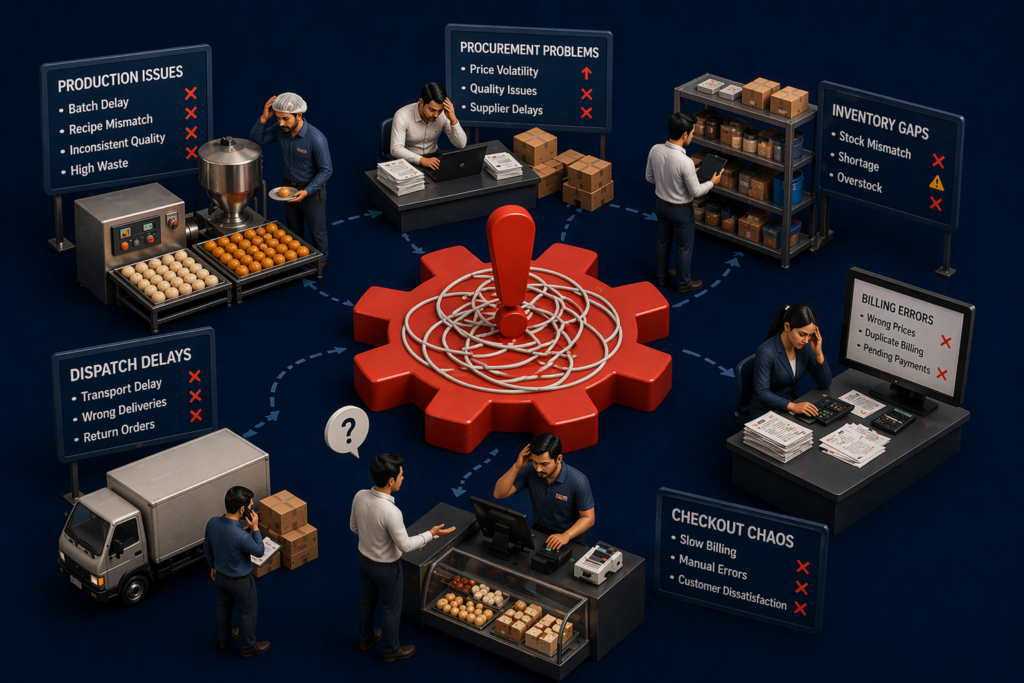
Before getting into solutions, it’s worth looking at what actually starts breaking when a sweets and namkeen business grows.
Not in theory.
But on the ground, especially during peak seasons.
Festival season chaos.
Demand spikes—but planning doesn’t keep up.
Production works at full capacity, but without clear demand visibility.
Some products run out mid-season, while others sit unsold.
Perishable inventory goes to waste, and you only see the impact weeks later in your numbers.
Procurement under pressure.
Raw materials, ghee, dry fruits, sugar are often purchased reactively, especially when markets are volatile.
There’s no structured comparison between vendors. No historical tracking of pricing or quality. Buying decisions happen in the moment, often at higher prices, just to keep production running.
No visibility across outlets.
As you expand from one outlet to multiple, clarity starts dropping.
You don’t know what’s actually selling where.
Each outlet becomes a separate unit. Restocking happens only when someone calls and says they’ve run out, not before.
The owner ends up becoming the system, constantly calling, checking, coordinating.
Inconsistent product quality.
Your recipes may be strong, but execution varies.
The same barfi tastes slightly different across outlets.
One batch of namkeen isn’t quite like the previous one.
There are no defined benchmarks or standardized recipes in place.
Quality depends on individuals and when they change, so does the product.
Distribution blind spots.
Once you move beyond your own outlets, visibility reduces further.
Orders come in late. Demand signals don’t reach production in time. Deliveries get rushed, delayed, or missed.
And the real issue?
You find out only after the distributor stops ordering.
Franchise coordination challenges.
Franchise expansion brings growth but also complexity.
Orders come through calls, messages, and informal channels.
There’s no single view of demand. Production and dispatch become reactive.
And over time, the biggest risk shows up, inconsistent experience across outlets.
The outlet counter bottleneck.
At the end of it all, everything comes down to the billing counter.
During peak hours, this is where pressure builds fastest.
Queues grow. Billing slows down. Mistakes happen.
And this is the only part of the business the customer actually sees.
No matter how strong your production or supply chain is, if the checkout experience breaks, the brand experience breaks with it.
These are not isolated issues.
They’re connected.
And they’re exactly what start holding a growing sweets and namkeen business back, not because demand isn’t there, but because the operations behind it aren’t built to handle scale.
What the Big Players Are Doing Differently
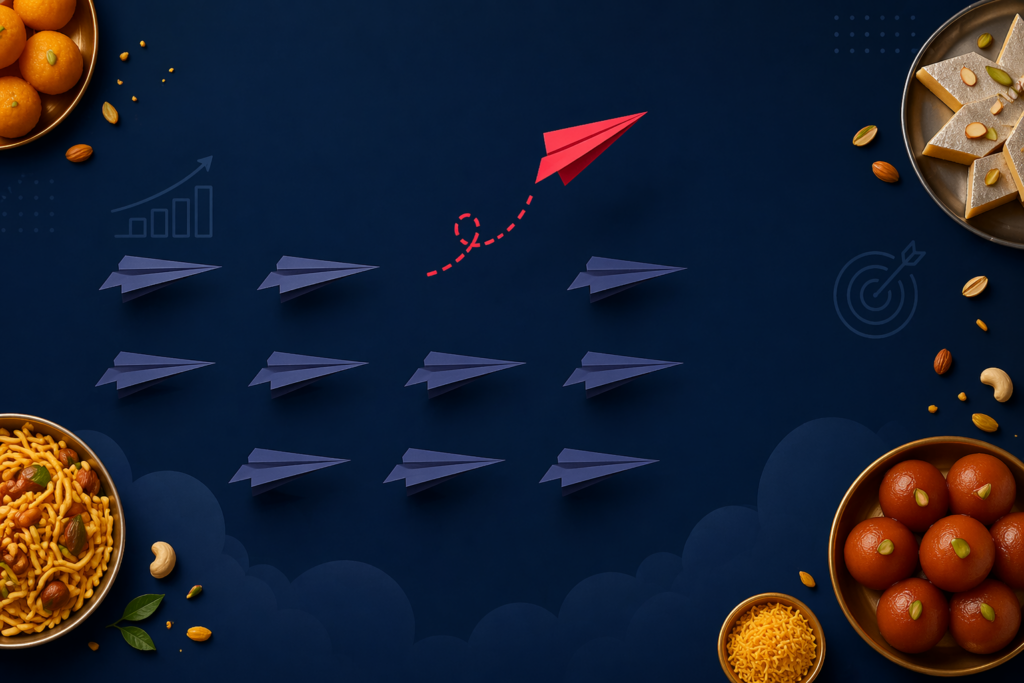
The brands leading in the sweets and namkeen industry didn’t get there by accident.
Their recipes work.
Their quality is trusted.
Their customers keep coming back.
That foundation doesn’t change.
What changes as they grow is how they run the business around that foundation.
Because as long as you’re operating at a smaller scale, experience and intuition can hold things together.
You know your demand.
You manage your teams closely.
You spot issues before they grow.
But as the business expands, more outlets, more products, more cities, that same approach starts getting stretched.
Not because it’s wrong.
But because the complexity increases.
What the larger players do differently is simple:
They don’t leave consistency to chance.
They apply food manufacturing systems that ensure the same quality, the same availability, and the same customer experience, no matter how much the business grows.
So the kitchen continues to do what it does best.
And the rest of the business is structured in a way that supports it, without constant firefighting.
That’s what allows a well-loved local brand to grow into something much bigger, without losing what made it successful in the first place.
Food Manufacturing Systems Behind Successful Scale
Scaling a sweets business isn’t just about selling more.
It’s about handling more without losing control.
Here are the food manufacturing systems that make that possible.
1. ERP — The Brain of the Operation
At the core of every sweets and namkeen business is production.
And as you scale, this is where inconsistency starts showing up first.
What changes when Byte Elephants’ ERP is in place:
Production becomes predictable.
You’re not guessing what to make, planning is based on actual demand and stock.
Recipes get standardized.
Every product, whether it’s kaju katli or mixture is defined in the system. Same ingredients, same quantities, every time.
Inventory stays under control.
Raw materials and finished goods are tracked in real time, reducing stockouts, overproduction, and wastage.
Batch traceability becomes effortless.
You know what was made, when, with what, and where it went, critical for both quality and compliance.
2. VMS — Bringing Control to Procurement
Procurement is where margins are quietly lost, or protected.
Especially in a sweets and namkeen business, where raw material quality and price fluctuate constantly.
What changes when Byte Elephants’ VMS is in place:
Buying becomes data-driven.
You’re not purchasing on gut feel, vendor pricing, history, and comparisons are available before every decision.
Market volatility is manageable.
Fluctuations in ghee, dry fruits, and other inputs are tracked so you don’t end up buying reactively at peak prices.
Quality checks are built in.
Every vendor and every batch can be evaluated, rejections, approvals, and consistency tracked over time.
Vendor performance becomes visible.
You know which suppliers are reliable, consistent, and worth scaling with.
2. SFA + DMS — Supporting Market Movement
As you expand beyond your outlets, distribution adds another layer.
What changes when Byte Elephants’ SFA-DMS are in place:
You get visibility into what’s selling, not just what’s dispatched.
Distributors and retailers stop being blind spots.
Your sales team becomes structured.
Orders, routes, and performance are tracked, reducing delays and missed demand.
Expansion into new areas becomes more controlled, not reactive.
4. FMS — The Franchise Controller
Franchising sounds like growth.
Until you try managing it manually.
Calls, messages, missed orders, inconsistent branding, it quickly turns into a coordination problem.
An FMS brings structure to that expansion.
What changes with Byte Elephants’ FMS:
Ordering becomes organized.
Franchisees place orders through a system, not scattered calls or messages. Demand becomes visible in one place, making production planning easier.
Consistency stops depending on people.
Brand audits, cleanliness, display, and process are tracked through apps. Issues are recorded, not ignored.
And performance becomes transparent.
Every outlet’s numbers, sales, orders, returns are visible without chasing updates.
You know where things are working, and where they’re slipping.
5. POS — Where Revenue, Customers, and Data Come Together
No matter how strong your production or distribution is, your business is ultimately judged at one place:
the billing counter.
This is where customers experience your brand.
And this is where most growing businesses still operate on disconnected systems.
What changes with Byte Elephants’ POS:
Every sale becomes visible instantly.
You don’t wait for end-of-day reports. You see outlet-wise performance in real time, what’s selling, where, and how fast.
Customer data stops being lost.
Every bill builds a centralized customer database across outlets. You start recognizing repeat buyers, understanding preferences, and tracking buying patterns.
Loyalty becomes structured, not manual.
Points, offers, festive promotions, all run through the system. Every customer gets a consistent experience, regardless of the outlet they visit.
Inventory stays in sync.
What gets sold is automatically reflected in stock. No mismatch between what’s billed and what’s available.
And most importantly,
Your outlets stop operating like independent shops and start functioning like one brand.
6. WMS — The Warehouse Layer
In a sweets and namkeen business, inventory isn’t just stock.
It’s a time-sensitive stock.
Shelf life, freshness, and batch movement matter just as much as quantity.
With Byte Elephants’ WMS:
FIFO/FEFO isn’t a guideline, it’s enforced.
Older batches move first, automatically.
Expiry losses reduce, not because someone remembered, but because the system ensured it.
Stock visibility becomes real.
Across factories, warehouses, distributors, and outlets, you know exactly what’s available, where.
Batch tracking becomes effortless.
Every product is tagged by production date and movement.
Traceability isn’t a separate effort, it’s built into how inventory moves.
7. HRMS — The People System
Behind every counter, every batch, every dispatch, there are people.
And as you grow, managing people becomes one of the hardest parts of scaling.
With Byte Elephants’ HRMS:
Hiring becomes faster.
New staff can be onboarded quickly, with roles and processes already defined.
Shifts stop being chaotic.
Early morning production, festive rush hours, multiple outlets, everything is scheduled systematically.
And payroll becomes predictable.
Attendance, salaries, compliance, handled without constant follow-ups or disputes.
Where Scaling Starts Going Right
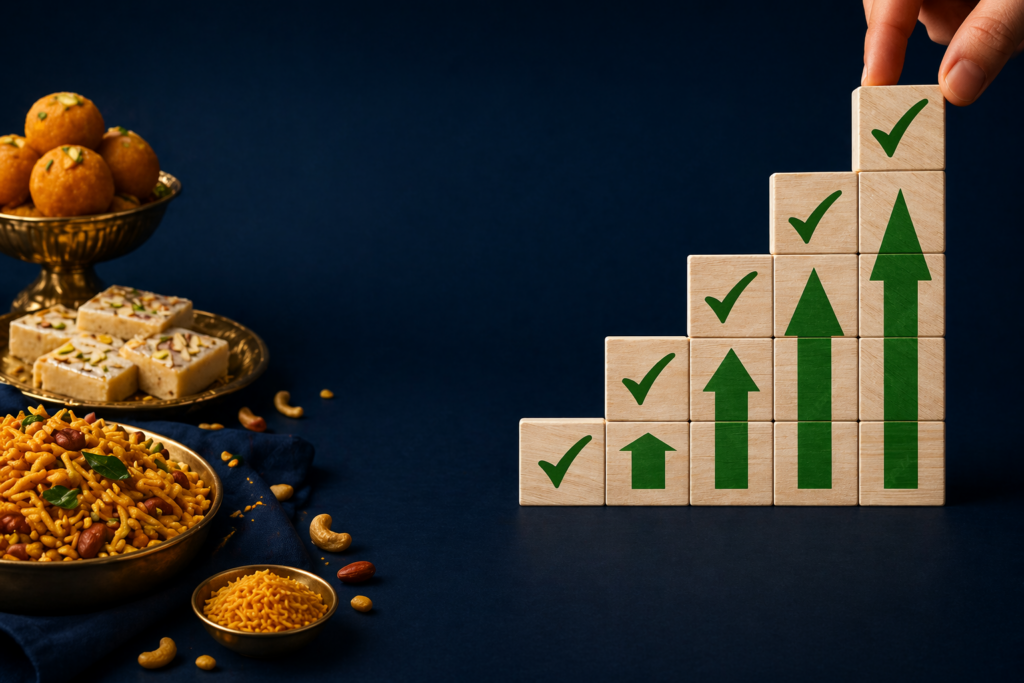
What sets growing sweets and namkeen brands apart isn’t just demand.
It’s the fact that they stop relying on memory, calls, and manual coordination, and start relying on connected food manufacturing systems.
Because scaling doesn’t break businesses.
Unstructured scaling does.
Businesses That Made the Right Shift with Food Manufacturing System

Take Kaka Halwai Sweet Center, a 130+ year-old sweets brand from Pune, operating across multiple plants and outlets.
Their challenge wasn’t demand.
It was coordination.
Different food manufacturing systems across plants and shops that didn’t speak to each other.
Data didn’t match. Visibility was limited.
And during peak seasons, the pressure showed up everywhere, from production to the outlet counter.
At some point, managing growth started feeling harder than achieving it.
What changed wasn’t the business.
It was how the business was run.
They began connecting key operations onto a single platform, step by step.
With Byte Elephants’ systems in place,
The result:
- Plants and outlets started working as one
- Data became consistent and reliable
- Decisions moved from reactive to structured
- Peak season chaos became manageable
Today, operations flow seamlessly, from procurement to production to the outlet counter.
Not because the business got simpler.
But because the way it runs did.

Take Madhvi Dairy, a fast-growing Gujarat-based brand with 30+ outlets across multiple cities.
Expansion was happening quickly, new outlets, new products, new markets.
But with growth came complexity.
Managing operations across locations, maintaining product consistency, and keeping visibility intact especially with a diverse range from dairy to sweets and ice creams started becoming challenging.
They didn’t slow down growth.
They brought structure to it.
With connected food manufacturing systems in place:
- Operations across outlets became more aligned
- Product consistency was easier to maintain
- Expansion became more controlled, not chaotic
Today, growth continues,
but with far better visibility and control across the business.
From Local Mithai Shop to a Scalable Brand
Growth is not sudden.
It is gradual, incremental, and built on what came before.
The businesses growing successfully in this industry are the ones that have figured out how to scale what already works — without losing control.
They are the ones who built the operational foundation to deliver that quality consistently, at scale, across every outlet, every distributor, every franchise, every city.
They didn’t start at the top.
They started where you are.
And they built, piece by piece.
The market is growing at over 10% every year.
The compliance requirements are getting stricter.
The organised players are getting more aggressive.
The window to build this foundation is open right now.
The recipe is already yours.
The demand is already there.
The only question is—
can your operations keep up?
See how sweets and namkeen brands keep growth sweet and operations under control. →