
Rajesh has been a salesperson for a FMCG distributor for six years.
He leaves home at 8 AM, covers 75 kilometres, visits 32 outlets, and logs a full nine-hour day.
His manager marks him as one of the hardest-working reps on the team.
But when you look at the numbers, Rajesh booked orders at 13 of those 32 outlets.
The other 19 visits, that is nearly 60% of his day, resulted in zero orders.
Some retailers had just stocked up from a competitor.
Some weren’t even open at the time he arrived.
A few were on the wrong beat entirely.
Rajesh isn’t the problem.
The beat is.
Across FMCG distribution networks in India, the single biggest advantage on field efficiency isn’t the salesperson, it’s the structure they’re given to operate in.
Beat route planning determines which outlets get visited, how often, in what sequence, and at what cost.
Get it wrong, and even your best reps are running hard just to stay in place.
What is Beat Route Planning in FMCG Distribution?

Beat route planning is simply the process of deciding which outlets a salesperson should visit, how often they should visit them, and the best order to cover them in.
The goal is straightforward: cover more outlets in less time while keeping travel and operational costs under control.
In FMCG sales, a beat is a fixed group of retail outlets assigned to a sales rep.
It could be 40 kirana stores within one local market or 25 outlets spread across a highway route.
A good beat is balanced.
The outlets are close enough to cover efficiently, the workload is realistic, and high-priority retailers get visited at the right frequency.
A bad beat creates the opposite problem.
Sales reps spend more time travelling, some outlets get ignored, and daily coverage drops.
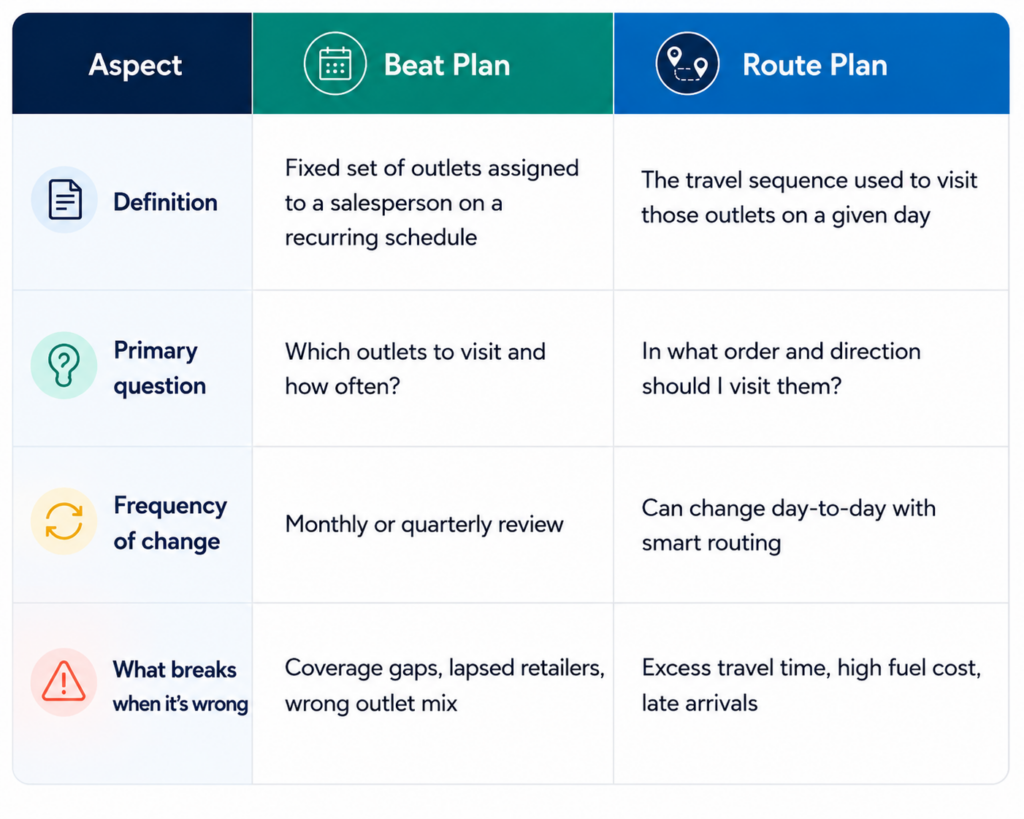
A beat plan and a route plan are not the same thing.
The beat defines which outlets belong together.
The route defines the order in which they are visited during the day.
Beat Plan vs. Route Plan
Why Poor Beat Planning Is Quietly Increases Distribution Costs
Most distribution managers track revenue.
They track target vs. achievement, primary sales, and scheme spend.
What they almost never track is cost per visit and that is exactly where poor beat planning hides.
The maths is straightforward.
Your field operation has a fixed daily cost: vehicle, fuel, salesperson salary, and travel allowance.
That cost is incurred whether your rep closes 5 orders or 25.
The only variable is how many of those visits are productive.
When your beat sends a rep to the wrong outlets, at the wrong time, in an inefficient sequence, you are paying the same cost for a fraction of the output
The hidden cost of unoptimised field visits
Take a typical FMCG salesperson covering a distributor network.
Daily field cost, vehicle depreciation, fuel, TA/DA, and salary allocation, is roughly ₹800 to ₹1,500 per day depending on the market and the distributor’s setup.
If that rep visits 30 outlets and closes 12 orders, the cost per order is ₹65 to ₹125.
Now restructure the beat.
Same rep, same day, same cost but the outlets are grouped more tightly, the sequence eliminates backtracking, and the visit timing matches when retailers actually buy.
The same 8 hours yields 22 orders instead of 12.
Cost per order drops to ₹36 to ₹68.
That is the 30% improvement and it came entirely from better planning, not from working the rep harder.
The hidden cost compounds further when you account for:
- TA/DA claims on wasted travel, kilometres claimed on inefficient routes that would not exist with a tighter beat
- Vehicle maintenance inflated by unnecessary distance covered
- Salesperson fatigue from long travel-heavy days reducing the quality of late-day visits
- Manager time spent reconciling visit reports that show activity but not results
What bad beat planning does to rates and sales coverage
Cost is one dimension.
The damage to coverage and fill rate is often worse.
When a beat is too large, salespersons cut corners, they skip low-value outlets or reduce dwell time at each stop to hit their visit count.
The result is surface-level coverage: technically visited, but with no meaningful selling conversation, no scheme communication, and no inventory check.
When visit frequency doesn’t match outlet demand, retailers run out of stock between visits.
A busy kirana that needs replenishment every five days but gets visited every ten will either substitute with a competitor’s product or simply run out, both outcomes are equally bad for the brand.
Signs Your Beat Route Plan Needs a Rethink

Before changing incentives or pushing the sales team harder, take a closer look at your beat structure.
In many cases, the real problem is not the salespeople.
It is the way the market has been planned.
1. Reps spend more time travelling than selling
A field rep should spend most of the day in front of retailers, not on the road. If salespeople are spending hours moving between scattered outlets, the beat is too large or poorly structured.
Long travel time reduces productive visits, increases fuel cost, and drains energy before the day ends.
2. High outlet visits but low order conversion
Visit count alone means very little. A rep visiting 35 outlets and closing 8 orders is less productive than someone visiting 20 outlets and closing 16. If order conversion rates are consistently low, the issue is usually poor outlet selection, bad visit timing, or inactive retailers still sitting in the beat plan.
3. Retailers frequently run out of stock
Not every outlet needs the same visit frequency. High-moving retailers need faster replenishment cycles than smaller stores. When beats are planned with a one-size-fits-all approach, retailers run out of stock between visits and start shifting to competing brands.
4. You need manual reports to spot weak beats
If managers can only identify underperforming beats after digging through spreadsheets and monthly reports, visibility is already too late. Beat-level performance should be easy to track daily, including outlet coverage, productive visits, and sales progress. Without that visibility, problems keep growing unnoticed.
Each of these signs has a direct cost.
An untracked beat isn’t just an operational inconvenience, it is margin walking out the door in the form of TA/DA on unproductive visits, scheme budget spent on retailers who aren’t the real target, and competitor gains on outlets your team doesn’t realise they’re losing.
The compounding effect is what makes it dangerous.
A bad beat in January causes coverage gaps in February, which allows a competitor entry in March, which reduces the retailer’s ordering frequency by April.
By the time the quarterly review flags the territory as underperforming, you’re four months behind.
How Byte Elephants Optimizes Beat Route Planning
Most distributors create beat plans once and keep using them for months, even when outlet demand, territory size, and market conditions change completely. Over time, beats become overloaded, some markets get ignored, and reps start covering outlets inefficiently.
BETs DMS Admin: Optimised Beat Planning and Distribution Control
BETs DMS Admin helps FMCG businesses optimise beat planning by giving management complete control over distributor operations, outlet allocation, territory structure, and sales visibility from a single platform.
Managers can organise distributor networks, monitor outlet coverage, track stock movement, and restructure territories whenever market demand shifts.
Instead of relying on disconnected Excel sheets and manual coordination, BETs connects primary sales, inventory visibility, order processing, distributor analytics, and reporting into one live system.
This allows businesses to reduce route inefficiencies, improve outlet coverage, strengthen distributor coordination, and support more structured beat execution across the FMCG network.
BETs SFA App: Optimised Route Execution on the Ground
The BETs Sales Force Automation app is designed around the actual beat-day workflow. The moment a rep checks in, the app displays the assigned beat, outlet list, route sequence, and daily targets.
As reps move through the market, every outlet visit is geofenced and timestamped. Orders, schemes, stock updates, and zero-order reasons are captured directly inside the app. Managers no longer rely on manual reporting to understand field activity.
The app also works offline, which is critical for rural routes and low-network areas where many FMCG field teams struggle with data sync issues.
BETs Sales Manager App: Live Beat Visibility Across Every Territory
BETs gives managers real-time visibility into beat execution while the day is still running. Area managers can instantly track rep check-ins, unvisited outlets, zero-order retailers, sales progress, and beat-wise activity across the market.
The platform connects field activity with distributor stock and sales data, helping leadership see the full picture instead of disconnected reports. Managers can quickly identify underperforming beats, overloaded territories, or reps losing time in transit and take corrective action immediately.
BETs Van Distribution Workflow: Built for On-the-Go FMCG Delivery
BETs structures van distribution around planned beat execution. Reps load inventory against the day’s outlet list, follow the planned route, generate invoices on the spot, collect payments, and close the day with inventory reconciliation.
This helps distributors reduce unnecessary travel, improve delivery efficiency, and maintain better stock availability across the market.
In van sales operations, efficient beat planning is not just about saving fuel. It directly affects service quality and sales continuity.
Businesses Getting It Right Treat the Beat as Their Most Valuable Asset
The most effective FMCG distribution teams in India don’t optimise their salespeople.
They optimise the system those salespeople work inside.
The beat is that system.
It determines which outlets get served, how consistently they get served, at what cost, and with what commercial result.
A 30% reduction in cost per visit is not unrealistic. It is usually the result of getting three things right at the same time: a well-structured beat that puts the right outlets in front of the right rep, a route that sequences those outlets intelligently, and a real-time system that gives managers visibility without waiting for end-of-month reports.
The brands and distributors pulling ahead in their markets right now have all three.
They’re not working harder than their competitors.
They’re working inside a better-designed system.
Byte Elephants builds that system.
The BETs DMS and SFA are purpose-built for the way FMCG distribution actually works, at the beat level, in the field, across the full channel hierarchy from stockist to retailer to manager to the General Manager’s dashboard.
Ready to see it in action?
See how BETs SFA-DMS gives you real-time beat and route visibility, from the rep’s check-in to the manager’s dashboard.
FAQs
Q1. What is beat route planning in FMCG distribution?
Beat route planning defines which retail outlets a salesperson visits (the beat), how often, and in what sequence (the route). Together they control cost per visit, fill rate, and territory productivity.
Q2. How does poor beat planning increase cost per visit for FMCG distributors?
Daily field costs like vehicle, fuel, TA/DA, and salary stay fixed. Poor beats send reps to wrong outlets with inefficient routes, so productive visits drop. Same cost, fewer orders = higher cost per visit.
Q3. How can FMCG distributors track beat performance in real time?
Through a mobile SFA app. Field reps check in with geofencing, log outlet-level orders, and flag zero-order visits. Managers see beat completion and unvisited outlet counts live, not in a monthly report.
Q4. What is a PJP and why does it matter in FMCG field sales?
A Permanent Journey Plan maps each rep to specific beats and outlets on set weekly days. It removes daily guesswork, ensures consistent outlet coverage, and gives managers a clear execution benchmark to track against.
Q5. What are the key KPIs to measure beat route efficiency?
The key KPIs are call effectiveness rate, beat completion rate, zero-order outlet count, average travel km per rep, fill rate by beat, and cost per productive visit. Review all six weekly, not monthly.