
Your distributor placed a ₹10 lakh order this week.
The invoice is raised, payment is on its way, and your primary sales report looks green.
Leadership is satisfied.
Targets are met.
Meanwhile, three districts away, a retailer who stocks your product hasn’t placed a reorder in 45 days.
A competitor’s SKU has quietly taken your shelf position.
This is the primary vs. secondary sales gap, one of the most consequential blind spots in FMCG distribution.
Primary numbers tell you what left your warehouse.
Secondary numbers tell you what’s actually selling.
And for most FMCG brands operating across a FMCG distribution network, real-time secondary sales visibility for FMCG distributors is still missing while only primary sales data is tracked consistently.
What Is Primary Sales in FMCG Manufacturers?
The flow: manufacturer to distributor
Primary sales refers to the first transaction in the FMCG distribution chain, the sale made by the manufacturer or brand directly to the distributor.
It is the most tracked, most reported, and most incentivised number in most FMCG organisations. It is also, on its own, one of the most misleading.
When your company raises an invoice to a distributor for a batch of goods and that distributor settles payment, a primary sale is recorded.
The stock has moved from your godown to theirs.
The targets are updated.
From a finance and planning perspective, the transaction is complete.
But the consumer hasn’t bought anything yet.
The retailer hasn’t been served.
And whether your product ever reaches the shelf is a question primary sales data simply cannot answer.
Why primary sales data alone is misleading
High primary sales numbers can easily coexist with distributor godowns full of slow-moving inventory, poor retailer coverage, and a shrinking shelf presence.
Brands that manage their business purely on primary numbers are, in effect, measuring the health of their distributor relationships, not the health of their market position.
What is Secondary sales visibility for FMCG distributors?
The flow: distributor to retailer / outlet
Secondary sales visibility for FMCG distributors refers to the transaction between the distributor and the retailer or outlet, it is the movement of stock from the distribution layer into the trade.
This is where real consumer demand signals live.
This is where your market share is either won or lost, SKU by SKU, outlet by outlet, beat by beat.
Secondary sales data captures what products a salesperson billed to which retailers on which day.
It tells you which outlets are active and buying regularly, which SKUs are moving, and which beats are underperforming.
Primary vs Secondary Sales: Key Differences at a Glance
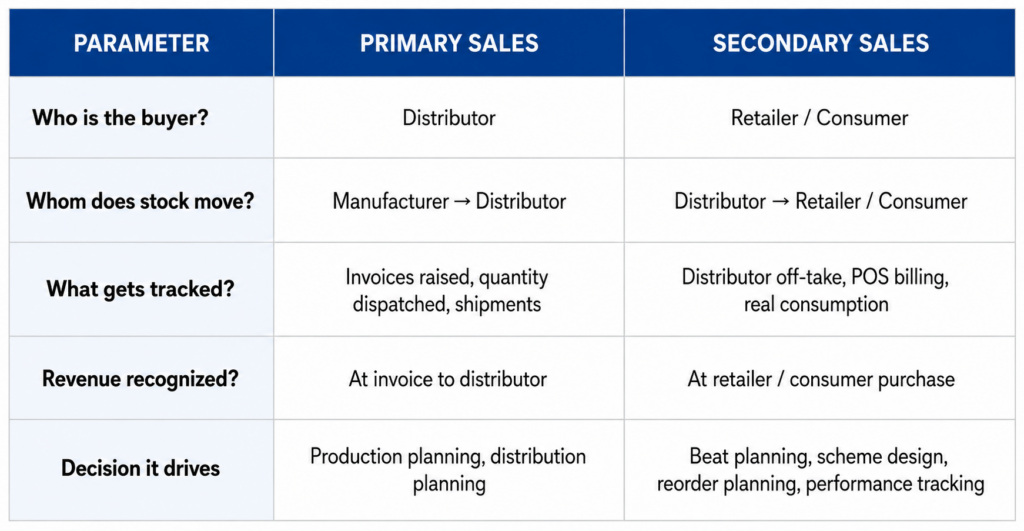
The result is a reporting setup that looks rigorous but operates with a fundamental information deficit.
Sales teams spend the last week of every month pushing distributors to lift stock, not because consumer demand warrants it, but because primary targets demand it.
Distributors accept the stock because schemes and credit terms make it financially rational in the short term.
And the market quietly accumulates invisible risk: excess inventory, lapsed retailers, and a growing gap between what’s reported and what’s real
This is not a failure of intent. It is a failure of data infrastructure.
5 Real Business Problems Caused by the Primary–Secondary Sales Gap

1. Distributor stock pileup and channel stuffing
When sales teams are incentivised on primary numbers, the temptation to push excess stock to distributors at month-end, often called channel stuffing and it becomes structural. Distributors receive the stock, the brand books the revenue, and primary targets are met.
But the stock doesn’t move to retail.
Distributor godowns fill up.
The next month’s order is smaller because there’s nothing to replenish. Worse, if the pushed SKUs have short shelf lives, returns start coming in.
The brand ends up reversing revenue it already celebrated, and the distributor relationship takes a quiet but lasting hit.
2. Scheme leakage and untracked promotions
Trade schemes, volume discounts, retailer incentives, free goods offers are almost always designed and tracked at the primary level.
The brand offers a benefit to the distributor.
Whether that benefit actually reaches the retailer is a separate question, and one that most brands cannot answer with any data.
Without secondary sales visibility for FMCG distributors, there is no way to verify that a scheme meant for retail outlets is being passed through the distributor correctly.
The result is scheme leakage: money spent on trade promotion that never reaches the intended recipient.
3. Inaccurate demand forecasting
Production planning and inventory forecasting that rely on primary sales numbers are, in effect, planning on ghost demand.
If a distributor lifted 10,000 units in March because of a scheme end, not because retailers were pulling stock then that March spike tells you nothing useful about April demand.
Secondary sales data, by contrast, reflects actual retailer offtake, the closest available proxy for real consumer demand. Brands with secondary visibility can separate genuine demand signals from distribution-layer noise, leading to better production planning, fewer stockouts in high-demand areas, and less waste in slow-moving territories.
4. Salesperson performance is impossible to measure
Without secondary data, there is no way to evaluate what a field sales executive actually achieved in a given week.
Did they cover their beat?
Which outlets did they visit?
How many orders did they generate?
What SKUs did they push?
These questions cannot be answered with only primary sales data.
They require outlet-level, beat-level, salesperson-level secondary tracking. Without it, performance management becomes subjective, based on self-reported call reports and manager intuition rather than verifiable data.
5. Poor market coverage and lost shelf space
Secondary data is the only mechanism through which a brand can identify lapsed retailers, low-coverage beats, and territory-level white space.
Without it, market coverage decisions are based on anecdote and assumption.
A retailer who ordered six months ago and hasn’t reordered since becomes invisible without secondary tracking.
A beat where coverage has dropped from 80% of outlets to 40% goes undetected.
A competitor quietly grows share in an underserved territory while the brand’s sales team reports “no issues.”
Shelf space, once lost, is expensive to recover.
The retailers who stop ordering are rarely flagged until a distributor mentions it, months after the damage is done.
What Real-Time Visibility Across Primary and Secondary Sales Looks Like
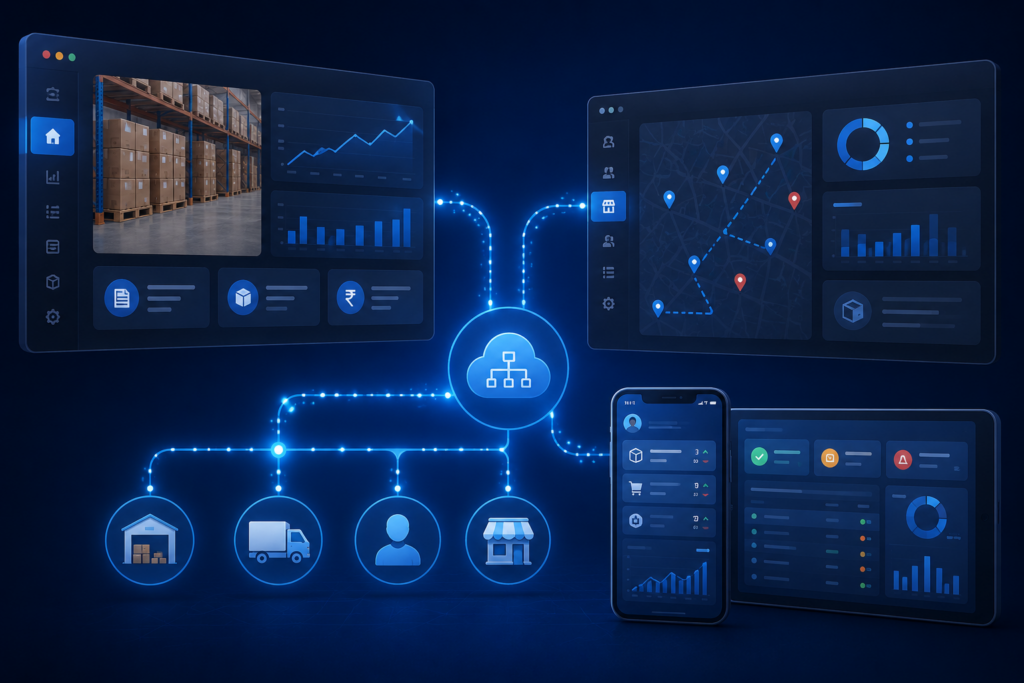
This is not a technology aspiration.
It is an operational requirement for any FMCG brand that wants to compete on distribution quality rather than just brand spend.
Live dashboards vs. monthly Excel reports: why the delay kills decisions
The traditional secondary sales reporting cycle looks like this:
field sales executives submit paper or WhatsApp-based reports at the end of each day.
These are consolidated by the area sales manager into a weekly summary.
The weekly summaries feed into a monthly regional review, which reaches the national team by the fifth of the following month.
By the time a decision-maker sees the data, it is between two and six weeks old.
A distributor problem that emerged in week one of the month is reviewed in week two of the next month.
A lapsed retailer who could have been re-engaged with a visit is now a lost customer.
Live dashboards collapse this timeline to zero.
A sales manager opening their system at 9 AM sees yesterday’s outlet-level billing data, current distributor stock positions, and beat coverage for the week.
Decisions happen on the real-time data.
Beat-level reporting: the most underused data asset in FMCG
The sales beat, the defined route that a field salesperson covers on a regular cycle is the atomic unit of FMCG distribution.
Every retail outlet belongs to a beat.
Every order originates from a beat visit.
Beat-level reporting, when tracked consistently, tells you not just what sold but where it sold, who sold it, and how reliably the coverage happened.
Despite being one of the most actionable datasets available, beat-level secondary data remains largely uncaptured in organisations that rely on manual reporting.
How SFA and DMS work together to close the primary–secondary gap
The integration of Sales Force Automation software and a Distribution Management System is what makes real-time secondary visibility operationally sustainable.
Here is how the BETs DMS suite makes this work in practice.
On the SFA side,
The field sales executive operates from a mobile app that handles the full workflow of a beat visit, from check-in to order confirmation to payment updates.
The app supports offline functionality for low-connectivity areas and syncs automatically when connectivity is restored.
Route optimization guides salesperson movement across assigned beats, while GPS-based punch-in and shop-to-shop tracking ensures beat plan adherence is verifiable, not self-reported.
At each outlet, the salesperson can view last order history, capture outlet inventory, apply promotional schemes and discounts automatically, and confirm orders with a WhatsApp-integrated notification to the retailer.
Performance analytics run in the background, comparing actual outlet coverage and order values against targets for every rep, every beat, every day.
On the Sales Manager App side,
Area managers and regional heads get a unified view that spans their entire territory, total check-ins, unvisited outlets, bill amounts, order amounts, and salesperson-wise summaries, all updated in real time.
The app supports downstream tracking and upstream reporting, meaning a zonal manager can drill down to individual rep activity while a VP Sales sees the consolidated picture across regions.
PJP and beat projection tools allow managers to adjust beat structures dynamically based on actual market demand, rather than once-a-year planning cycles.
On the DMS side,
The primary distribution layer is managed through a configurable order booking and invoicing system that handles the full range of distributor operations:
supplier invoice reflection, downstream invoice generation, auto replenishment, FIFO-based goods return management, auto credit note generation, and 30+ MIS reports specific to individual distributors.
The DMS Admin tool gives top management control over the entire sales hierarchy from GM down to area sales manager including the ability to set and track targets, design pricing and scheme structures, and monitor performance metrics across every level of the organisation.
When SFA captures secondary sales at the outlet level and DMS reconciles them against distributor stock and primary billing, the brand gains something most FMCG organisations have never had:
a single, live view of the entire distribution chain, from the manufacturer’s invoice to the retailer’s shelf.
Closing the Gap: Why the Best FMCG Brands Act on Secondary Data, Not Just Primary Numbers
The FMCG brands that consistently outperform their competition in shelf presence, market penetration, and distribution ROI share a common characteristic:
they operate with connected visibility across the distribution chain.
They do not treat secondary sales as an isolated report generated at the end of the month.
They build operational ecosystems where primary sales, secondary movement, distributor activity, inventory flow, retail execution, and field sales performance are continuously connected.
This is where integrated FMCG technology platforms become critical.
At Byte Elephants Technologies, this visibility is enabled through a suite-based ecosystem designed specifically for FMCG and distribution-driven businesses.
The BETs Distribution Management System (DMS) and Sales Force Automation (SFA) solutions help businesses monitor downstream sales activity, retailer movement, beat performance, outlet ordering behavior, stock visibility, and sales execution in real time.
At the same time, connected platforms like ERP, Warehouse Management Systems (WMS), POS systems, Franchise Management Systems (FMS), HRMS, and Vendor Management Systems (VMS) ensure operational data does not remain fragmented across departments.
Instead of disconnected reports, businesses gain a unified operational view — from warehouse dispatch to distributor movement to retailer shelf activity.
This allows leadership teams to identify non-moving stock, inactive outlets, declining territories, fulfillment gaps, and execution inefficiencies before they become revenue problems.
A mid-market FMCG brand with a well-implemented SFA and DMS has more actionable market intelligence than a large company relying on monthly consolidated reports.
The gap between primary and secondary sales is not going to close by itself.
It closes when brands invest in the systems that make secondary data as visible, reliable, and actionable as primary data already is.
See how BETs SFA gives you real-time secondary sales visibility
Frequently Asked Questions
Q1. What is the difference between primary sales and secondary sales in FMCG?
Primary sales are sales from the brand to the distributor, while secondary sales are sales from the distributor to retailers. Primary sales show stock dispatched; secondary sales show actual market demand.
Q2. Why is secondary sales visibility important for FMCG distributors? Because distributor performance and market performance are not the same thing. A distributor can keep ordering while retailer coverage quietly collapses. Without secondary data, that gap stays invisible until it’s too late to fix.
Q3. How can FMCG businesses track secondary sales in real time?
By digitising both ends of the secondary transaction, field sales executives capture outlet orders via an SFA app, and distributor billing flows through a connected DMS.
Q4. What are the key KPIs to measure secondary sales performance? Beat-wise outlet coverage rate, active vs. lapsed outlet count, SKU-wise secondary volume vs. target, scheme redemption, zero-order outlet tracking, and salesperson orders per day. Weekly review cadence is recommended for all of these.
Q5. What is channel stuffing and how does it relate to secondary sales? Channel stuffing is when brands push excess stock to distributors to hit primary targets, regardless of actual retailer demand. It inflates short-term numbers but causes godown pile-up, return spikes, and distorted forecasting. It only persists when secondary data is absent.